
Medical Disclaimer
The information on this website is for educational purposes only and is not a substitute for professional medical advice, diagnosis, or treatment. Always consult a qualified healthcare provider before starting any hormone therapy. Individual results may vary. TRTmatch does not provide medical services or prescribe medications.
Key Takeaways
- Sleep is the single most impactful natural lever for testosterone — targeting 7–9 hours per night can meaningfully raise levels within days of improvement.
- Resistance training (compound lifts, 3–4x per week) and HIIT are the most effective exercise strategies for supporting healthy testosterone production.
- Key nutrients — especially zinc, vitamin D, and magnesium — are directly involved in testosterone synthesis and are commonly deficient in men with low T.
- Chronic stress elevates cortisol, which suppresses the hormonal axis responsible for testosterone production; managing stress is as important as diet and exercise.
- Excess body fat increases aromatase activity, converting testosterone to estrogen — losing even 10–15% of body weight can raise testosterone levels significantly.
- If consistent lifestyle changes over 3–6 months don't resolve symptoms, clinically low testosterone may warrant a conversation with a qualified TRT provider.
Disclaimer: This article is for educational purposes only and does not constitute medical advice. Always consult a qualified healthcare provider before making changes to your health regimen or considering hormone therapy.
If you've been feeling sluggish, losing muscle despite working out, or noticing a dip in your sex drive, your testosterone levels may be worth examining. Understanding how to increase testosterone naturally is often the smartest first move — before jumping straight to medical treatment. While testosterone replacement therapy (TRT) is a highly effective, FDA-recognized option for clinically low testosterone, many men can meaningfully raise their levels through targeted lifestyle changes. This guide walks you through what the science actually supports.

Why Testosterone Levels Decline — And Why It Matters
Testosterone is the primary male sex hormone, responsible for muscle mass, bone density, libido, mood regulation, and energy metabolism. After age 30, most men experience a natural decline of roughly 1–2% per year — a process sometimes called andropause or male hypogonadism when levels fall significantly below the normal range.
But age isn't the only driver. Low testosterone in men is frequently linked to lifestyle factors including poor sleep, chronic stress, excess body fat, sedentary behavior, and nutritional deficiencies. The encouraging news: these are all modifiable. Research consistently shows that men who address these root causes can see meaningful improvements in their total and free testosterone levels — sometimes enough to resolve symptoms entirely.
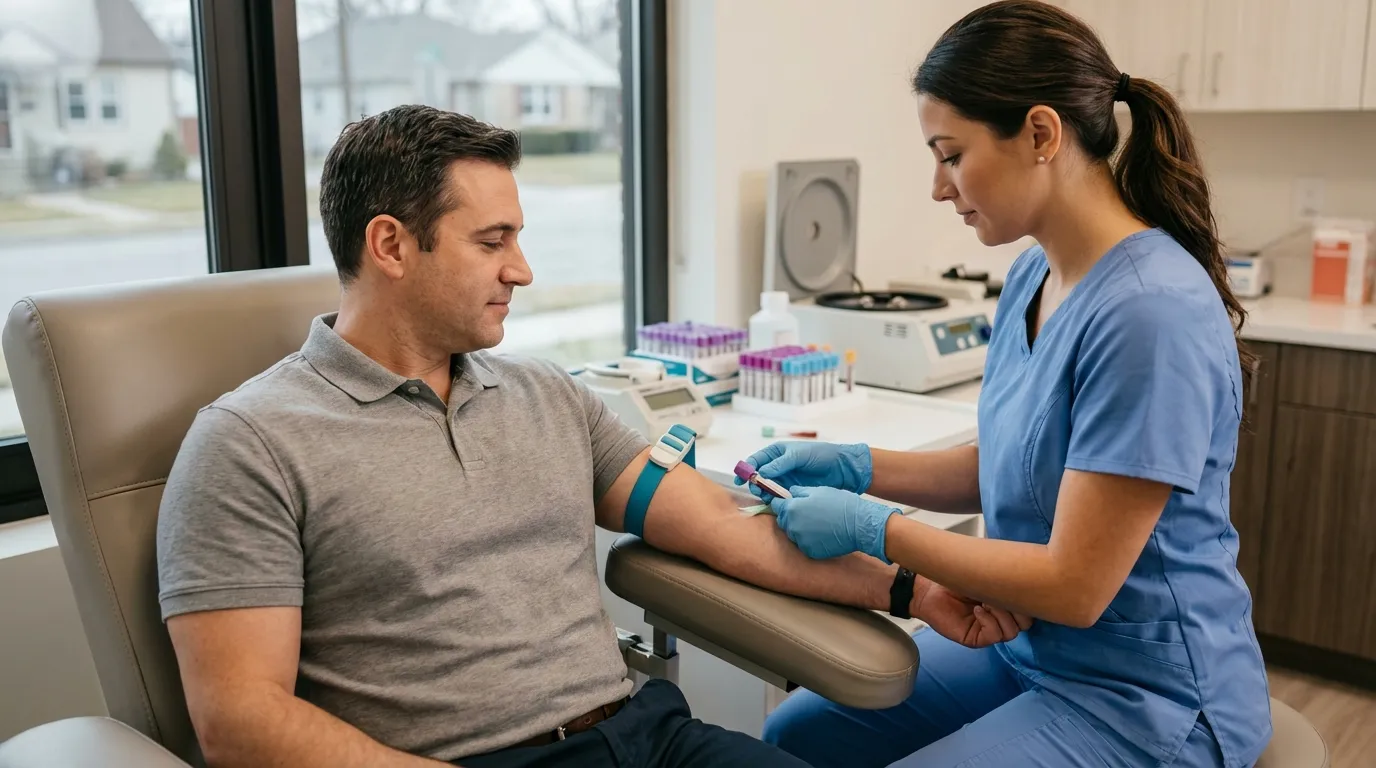
To understand where you stand, it helps to review testosterone levels by age. The normal range for adult men is generally 300–1,000 ng/dL, though symptoms can vary widely even within that window. If you're experiencing signs of low testosterone — fatigue, brain fog, reduced motivation, or low libido — getting a baseline blood test is the logical first step before anything else.
Wondering whether your symptoms add up? Take the free Low T symptom quiz to get a clearer picture in under two minutes.
How to Increase Testosterone Naturally Through Sleep Optimization
If there's one lifestyle lever with the most immediate and measurable impact on testosterone, it's sleep. Multiple peer-reviewed studies confirm that sleep deprivation significantly suppresses testosterone production. A landmark study published in the Journal of the American Medical Association (JAMA) found that men who slept just five hours per night for one week had testosterone levels 10–15% lower than their well-rested baseline — equivalent to aging 10–15 years in hormonal terms.
Testosterone is predominantly synthesized during slow-wave (deep) sleep and REM cycles. When you cut sleep short or experience fragmented sleep due to stress, alcohol, or undiagnosed sleep apnea, your body simply has less time to produce it. Men with obstructive sleep apnea, for example, tend to have significantly lower testosterone levels even when controlling for age and body weight.
Practical Sleep Strategies to Support Testosterone
- Target 7–9 hours per night. This is the evidence-based sweet spot for hormonal health in adult men.
- Maintain a consistent sleep schedule. Going to bed and waking at the same time daily stabilizes your circadian rhythm, which directly regulates testosterone pulses.
- Reduce blue light exposure 60–90 minutes before bed. Blue light suppresses melatonin, which disrupts the hormonal cascade that primes overnight testosterone synthesis.
- Keep your bedroom cool (65–68°F / 18–20°C). Core body temperature drops during sleep, and cooler environments support deeper sleep stages.
- Limit alcohol before bed. Even moderate alcohol consumption impairs sleep quality and has been shown to directly suppress testosterone production at the testicular level.
If you suspect sleep apnea — indicated by loud snoring, daytime fatigue, or waking unrefreshed — speak with your doctor. Treating sleep apnea alone has been shown to raise testosterone levels in some men without any other intervention.

Exercise: The Most Powerful Natural Testosterone Booster
Regular physical activity is one of the most well-documented ways to support healthy testosterone levels — but not all exercise is created equal. The type, intensity, and duration of your workouts all influence the hormonal response.
Resistance Training
Lifting weights — particularly compound movements like squats, deadlifts, and bench press — produces the most robust acute testosterone response of any exercise modality. Research published in the European Journal of Applied Physiology shows that multi-joint, high-load resistance exercise triggers significant short-term testosterone spikes and, over time, contributes to improved resting testosterone levels, especially in men who are sedentary or overweight. Aim for 3–4 sessions per week using moderate-to-heavy loads (70–85% of your one-rep max) with rest periods of 60–90 seconds between sets.
High-Intensity Interval Training (HIIT)
HIIT — alternating short bursts of maximal effort with brief recovery periods — has also been shown to elevate testosterone, particularly in overweight men. A 2012 study in the Journal of Strength and Conditioning Research found that HIIT produced greater testosterone responses than steady-state cardio in comparable training sessions. A practical protocol: 20–30 minutes of sprint intervals (e.g., 30 seconds on, 90 seconds off) 2–3 times per week.
The Overtraining Caveat
More is not always better. Excessive endurance training — particularly marathon running or cycling at high weekly volumes — has been associated with suppressed testosterone and elevated cortisol. If you're training more than 10–12 hours per week without adequate recovery, you may actually be working against your hormonal health. Balance is key: train hard, recover harder.
Nutrition and Diet: Eating to Support Healthy Testosterone
What you eat directly influences your hormonal environment. Testosterone is synthesized from cholesterol, which means dietary fat is not the enemy — it's a building block. Severely low-fat diets have been associated with reduced testosterone levels in multiple studies.
Key Nutrients for Testosterone Production
| Nutrient | Role in Testosterone | Top Food Sources |
|---|---|---|
| Zinc | Essential cofactor for testosterone synthesis; deficiency directly lowers levels | Oysters, beef, pumpkin seeds, chickpeas |
| Vitamin D | Functions as a steroid hormone precursor; low levels linked to low testosterone | Fatty fish, egg yolks, fortified dairy, sunlight |
| Magnesium | Supports free testosterone by reducing SHBG binding | Spinach, almonds, dark chocolate, avocado |
| Healthy Fats | Provide cholesterol substrate for testosterone synthesis | Olive oil, avocados, eggs, nuts, fatty fish |
| Protein | Supports muscle mass and reduces fat mass, both linked to higher testosterone | Chicken, beef, eggs, Greek yogurt, legumes |
Conversely, excess sugar and processed carbohydrates drive insulin resistance and fat accumulation — both of which are associated with lower testosterone. Ultra-processed foods, trans fats, and excessive alcohol should be minimized. A whole-food diet resembling a Mediterranean pattern — rich in vegetables, lean protein, healthy fats, and complex carbohydrates — consistently outperforms restrictive diets for long-term hormonal health.
Vitamin D deserves special mention: research from the Hormone and Metabolic Research journal found that men supplementing with 3,332 IU of vitamin D daily for one year had significantly higher testosterone levels than those taking a placebo. If you live in a northern climate or work indoors, supplementing with 2,000–4,000 IU of vitamin D3 daily is a reasonable, low-risk strategy worth discussing with your doctor.
Stress Management and Cortisol: The Testosterone Killer
Cortisol and testosterone have an inverse relationship — when one goes up, the other tends to go down. Chronic stress keeps cortisol chronically elevated, and sustained high cortisol suppresses the hypothalamic-pituitary-gonadal (HPG) axis — the hormonal feedback loop that governs testosterone production. In practical terms, this means that a high-stress lifestyle can blunt your testosterone levels even if your diet and exercise are dialed in.
Psychological stress — from work pressure, financial anxiety, relationship conflict, or chronic overcommitment — has measurable biological consequences. A study in Psychoneuroendocrinology demonstrated that men with chronically elevated perceived stress had significantly lower testosterone and higher cortisol than their lower-stress counterparts, independent of exercise and sleep habits.
Evidence-Based Stress Reduction Tools
- Mindfulness meditation: Even 10–15 minutes of daily mindfulness practice has been shown to lower cortisol and improve hormonal balance over 8 weeks.
- Ashwagandha (Withania somnifera): One of the few herbal supplements with solid clinical evidence. A double-blind, randomized controlled trial published in Medicine found that men taking 600 mg of ashwagandha root extract daily for 8 weeks experienced a 14.7% increase in testosterone and a 27.9% reduction in cortisol compared to placebo.
- Social connection and purpose: Strong social bonds are associated with healthier cortisol rhythms and better testosterone levels in aging men.
- Time in nature: Forest bathing and outdoor activity have measurable effects on cortisol reduction, indirectly supporting testosterone balance.
Managing stress is not a luxury — it's a core pillar of hormonal health. If stress is a consistent part of your life, addressing it directly will likely yield results faster than any single supplement.
Body Composition: Why Losing Body Fat Matters for Testosterone
Adipose (fat) tissue, particularly visceral fat stored around the abdomen, contains an enzyme called aromatase that converts testosterone into estradiol (estrogen). The more visceral fat you carry, the more testosterone gets converted — creating a self-reinforcing cycle of low testosterone and weight gain. This is one reason why low testosterone symptoms after 40 often coincide with increasing belly fat.
The good news: losing body fat — even modest amounts — measurably raises testosterone. A meta-analysis published in Obesity Reviews found that for every unit decrease in BMI, testosterone increased by approximately 7 ng/dL. Men who lost 15–20% of their body weight through diet and exercise in clinical trials showed testosterone improvements of 20–30% in some cases — without any pharmaceutical intervention.
Sustainable weight loss (0.5–1 lb per week), achieved through a modest caloric deficit combined with resistance training and adequate protein, is the most effective body composition strategy for testosterone optimization. Crash diets and extreme caloric restriction, by contrast, can actually suppress testosterone by triggering metabolic adaptation and nutrient deficiency.
Reducing Alcohol and Avoiding Testosterone-Suppressing Substances
Alcohol directly interferes with testosterone production through multiple pathways. It impairs the liver's ability to metabolize estrogen, increases aromatase activity, and damages Leydig cells in the testes — the cells responsible for producing testosterone. Research shows that chronic heavy drinking can reduce testosterone levels by 6.5–50% depending on consumption levels and individual factors. Even moderate drinking (more than 2 drinks per night regularly) has measurable suppressive effects on testosterone in men.
Beyond alcohol, several other substances and environmental factors can affect testosterone:
- Endocrine-disrupting chemicals (EDCs): Found in plastics (BPA), pesticides, and certain personal care products. Minimize exposure by choosing BPA-free containers, eating organic when feasible, and using fragrance-free personal care products.
- Opioid medications: Prescription opioids are among the most potent suppressors of testosterone, a condition called opioid-induced androgen deficiency (OPIAD). If you're on opioids long-term and experiencing low T symptoms, discuss this with your provider.
- Excessive cannabis use: Some research suggests heavy cannabis use can acutely suppress testosterone, though evidence remains mixed and dose-dependent.
Small reductions in alcohol intake and conscious avoidance of known hormone disruptors can contribute meaningfully to your overall testosterone optimization strategy over time.
When Natural Strategies Aren't Enough: Considering TRT
Lifestyle optimization is always the right starting point — but it has real limits. If your testosterone levels are clinically low (typically below 300 ng/dL on two separate morning blood tests), and you're experiencing persistent symptoms despite consistent lifestyle improvements, testosterone replacement therapy may be the appropriate next step.
TRT is a well-established, FDA-recognized medical treatment that has helped millions of men recover their quality of life. It's not a shortcut or a last resort — it's a clinical tool used when the body's natural production is genuinely insufficient. Understanding how to increase testosterone naturally matters because it helps you arrive at that conversation with your doctor already having optimized what you can control — making any treatment decision more informed and more effective.
When lifestyle changes alone haven't moved the needle after 3–6 months of consistent effort, working with a qualified TRT provider is the logical next step. Find a TRT clinic near you through our directory, or explore options in your state — including TRT clinics in Texas, TRT clinics in California, and TRT clinics in Florida. A good provider will start with comprehensive testosterone blood testing, assess your full hormonal picture including free vs total testosterone, and build a personalized plan.
Not sure if your symptoms warrant a clinical conversation? Take the free Low T symptom quiz as a starting point, then explore how to find a TRT doctor who can guide you through the process with confidence. The goal is always the same: helping you feel your best — through natural strategies, clinical support, or both working together.
Sources & References
- Effect of 1 Week of Sleep Restriction on Testosterone Levels in Young Healthy Men — Journal of the American Medical Association (JAMA) [Link]
- Testosterone and Cortisol in Relationship to Dietary Nutrients and Resistance Exercise — Journal of Applied Physiology (PubMed) [Link]
- Effect of Vitamin D Supplementation on Testosterone Levels in Men — Hormone and Metabolic Research (PubMed) [Link]
- Examining the Effect of Withania somnifera Supplementation on Muscle Strength and Recovery: A Randomized Controlled Trial — Journal of the International Society of Sports Nutrition (PubMed) [Link]
- Testosterone Deficiency — AUA Guideline — American Urological Association (AUA) [Link]
- Obesity and Male Reproductive Function — Obesity Reviews (PubMed) [Link]
- Alcohol and Hormones — Alcohol Research & Health (NIAAA) [Link]
- Testosterone and Aging: Clinical Research Directions — National Academies Press / PubMed [Link]
Frequently Asked Questions
Ready to Take the Next Step?
Check your symptoms with our free quiz or browse 2,500+ verified TRT clinics.